
Analyzing Dengue Transmission Through a Two-Age-Class Host Population Model
Article Sidebar
Main Article Content
 https://orcid.org/0000-0002-7163-2182
Abstract
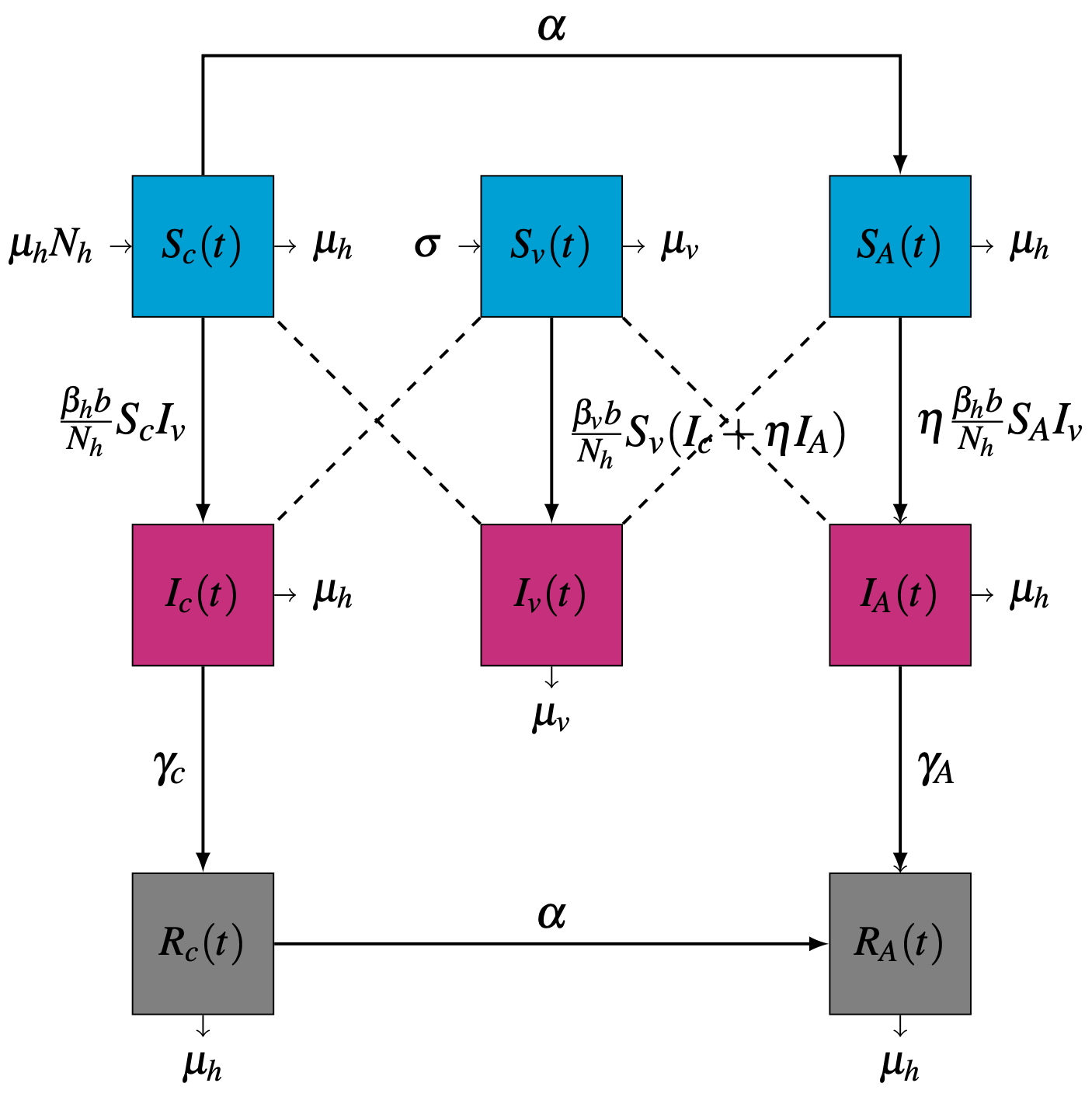
Age is an important risk factor for vector-borne diseases such as dengue. Children are more exposed to mosquito bites than adults due to behavioral and environmental factors. This study extends the classical host-vector modeling framework by incorporating the human population divided into two age classes, i.e, children and adults. The model also introduces additional key biological parameters, such as $b$, the number of mosquito bites per day; $\sigma$, the intrinsic growth rate of the mosquito population; and $\eta$, the relative probability that a mosquito bites an adult rather than a child. We derive the basic reproduction number using the next-generation matrix method and analyze the local stability of the disease-free equilibrium. Furthermore, we obtain sufficient conditions for the local asymptotic stability of the endemic equilibrium in a specific case. Sensitivity analysis is discussed to identify parameters that have the most influence. The numerical simulations are provided to support the theoretical results.
Article Details

This work is licensed under a Creative Commons Attribution-NonCommercial 4.0 International License.
References
[1] WHO. Dengue and severe dengueDengue and severe dengue; 2023.
[2] Sari ER, Puspita NP, Farah RN. Prevention of dengue virus transmission: insights from host-vector mathematical model. Mathematical Modelling and Control. 2025;5(2):131-46. doi:10.3934/mmc.2025010.
[3] Hasan MR, Hobiny A, Alshehri A. Analysis of Vector-host SEIR-SEI Dengue Epidemiological Model. International Journal of Analysis and Applications. 2022;20:57. doi:10.28924/2291-8639-20-2022-57.
[4] Sari ER, Insani N, Lestari D. The Preventive Control of a Dengue Disease Using Pontryagin Minimum Princi- pal. In: Journal of Physics: Conference Series. vol. 855. IOP Publishing; 2017. p. 12045. doi:10.1088/1742- 6596/855/1/012045.
[5] Sari ER. Stability Analysis of Dengue Disease Using Host–Vector Model. Recent Advances in Mathematical Sciences. 2016:83-98. doi:10.1007/978-981-10-0519-0_8.
[6] Blante TP, Jaharuddin, Nugrahani EH. Sensitivity Analysis of SI1 I2 RS Model for Dengue Fever Transmission. Jambura Journal of Biomathematics. 2024;5(1):19-26. doi:10.37905/jjbm.v5i1.23132.
[7] Aprianti E, Sonia S. Stability and Sensitivity Analysis of Parameters in the SEIR-ASEI Model for the Transmission of Dengue Fever. Jambura Journal of Biomathematics. 2025;6(4):340-9. doi:10.37905/jjbm.v6i4.32754.
[8] Wardhani R, Widowati W, Sunarsih S. Mathematical modeling of dengue hemorrhagic fever transmission: Anal- ysis and numerical simulation. In: AIP Conference Proceedings. vol. 3301. AIP Publishing LLC; 2025. p. 40002. doi:10.1063/5.0267963.
[9] Rodrigues HS, Monteiro MTT, Torres DFM, Zinober A. Dengue disease, basic reproduction number and control. International Journal of Computer Mathematics. 2012;89(3):334-46. doi:10.1080/00207160.2011.554540.
[10] Li-Martín A, Reyes-Carreto R, Vargas-De-León C. Dynamics of a dengue disease transmission model with two-stage structure in the human population. Mathematical Biosciences and Engineering. 2023;20(1):955-74. doi:10.3934/mbe.2023044.
[11] Pongsumpun P, Tang IM. A realistic age structured transmission model for dengue hemorrhagic fever in Thailand. Southeast Asian Journal of Tropical Medicine and Public Health. 2001;32(2):336-40.
[12] Pongsumpun P, Tang IM. Transmission of dengue hemorrhagic fever in an age structured population. Mathematical and Computer Modelling. 2003;37(9-10):949-61. doi:10.1016/S0895-7177(03)00111-0.
[13] Supriatna AK, Soewono E, van Gils SA. A two-age-classes dengue transmission model. Mathematical Biosciences. 2008;216(1):114-21. doi:10.1016/j.mbs.2008.08.011.
[14] Puspita JW, Nuraini N, Soewono E. Optimal Vaccination Strategy in 2-age-structure Model for Dengue Transmission in Semarang City, Central Java Province, Indonesia. In: AIP Conference Proceedings. vol. 2867. AIP Publishing LLC; 2024. p. 20006. doi:10.1063/5.0225057.
[15] Kongsomboon K, Singhasivanon P, Kaewkungwal J, Nimmannitya S, Mammen MP, Nisalak A, et al. Temporal trends of dengue fever/dengue hemorrhagic fever in Bangkok, Thailand from 1981 to 2000: An age-period-cohort analysis. Southeast Asian Journal of Tropical Medicine and Public Health. 2004;35(4):913-7.
[16] Taurel AF, Luong CQ, Thao Nguyen TT, Do KQ, Diep TH, Nguyen TV, et al. Age distribution of dengue cases in southern vietnam from 2000 to 2015. PLoS Neglected Tropical Diseases. 2023;17(2):e0011137. doi:10.1371/journal.pntd.0011137.
[17] Teng AK, Singh S. Epidemiology and new initiatives in the prevention and control of dengue in Malaysia. Dengue Bulletin. 2001;25:7-14.
[18] Ooi EE, Goh KT, Gubler DJ. Dengue prevention and 35 years of vector control in Singapore. Emerging Infectious Diseases. 2006;12(6):887-93. doi:10.3201/eid1206.051210.
[19] Prayitno A, Taurel AF, Nealon J, Satari HI, Karyanti MR, Sekartini R, et al. Correction to: Dengue seroprevalence and force of primary infection in a representative population of urban dwelling Indonesian children (Public Library of Science). PLoS Neglected Tropical Diseases. 2018;12(5):e0005621. doi:10.1371/journal.pntd.0006467.
[20] Jackson A. Dengue’s deadly impact on children | WMP; 2022.
[21] Van Den Driessche P, Watmough J. Reproduction numbers and sub-threshold endemic equilibria for compart- mental models of disease transmission. Mathematical Biosciences. 2002;180(1-2):29-48. doi:10.1016/S0025- 5564(02)00108-6.
[22] Odio CD, Sánchez-González L, Delorey M, Adams LE, Jones ES, Lorenzi O, et al. The Effect of Age on Dengue Presenta- tion and the Diagnostic Accuracy of the 2015 Pan American Health Organization Case Criteria in a Puerto Rican Cohort. In: Open Forum Infectious Diseases. vol. 10. Oxford University Press US; 2023. p. ofad373. doi:10.1093/ofid/ofad373.
[23] Diamond MS, Pierson TC. Molecular Insight into Dengue Virus Pathogenesis and Its Implications for Disease Control. Cell. 2015;162(3):488-92. doi:10.1016/j.cell.2015.07.005.
[24] Ng WY, Atan R, Yunos NM, Bin Md Kamal AH, Roslan MH, Quah KY, et al. A double whammy: The association between comorbidities and severe dengue among adult patients—A matched case-control study. PLoS ONE. 2022;17(9 September):e0273071. doi:10.1371/journal.pone.0273071.
[25] Sarwar M, Rasool B. Seasonal Prevalence and Phenomenal Biology as Tools for Dengue Mosquito Aedes aegypti (Linnaeus) (Diptera: Culicidae) Management. Brazilian Archives of Biology and Technology. 2022;65:e22220050. doi:10.1590/1678-4324-2022220050.