
Anaysis of Predator-Prey Dynamics Using Holling Type I & II Response Functions with Kleptoparasitism and Anti-Predator Behavior
Article Sidebar
Main Article Content
 https://orcid.org/0000-0002-8064-7191
Abstract
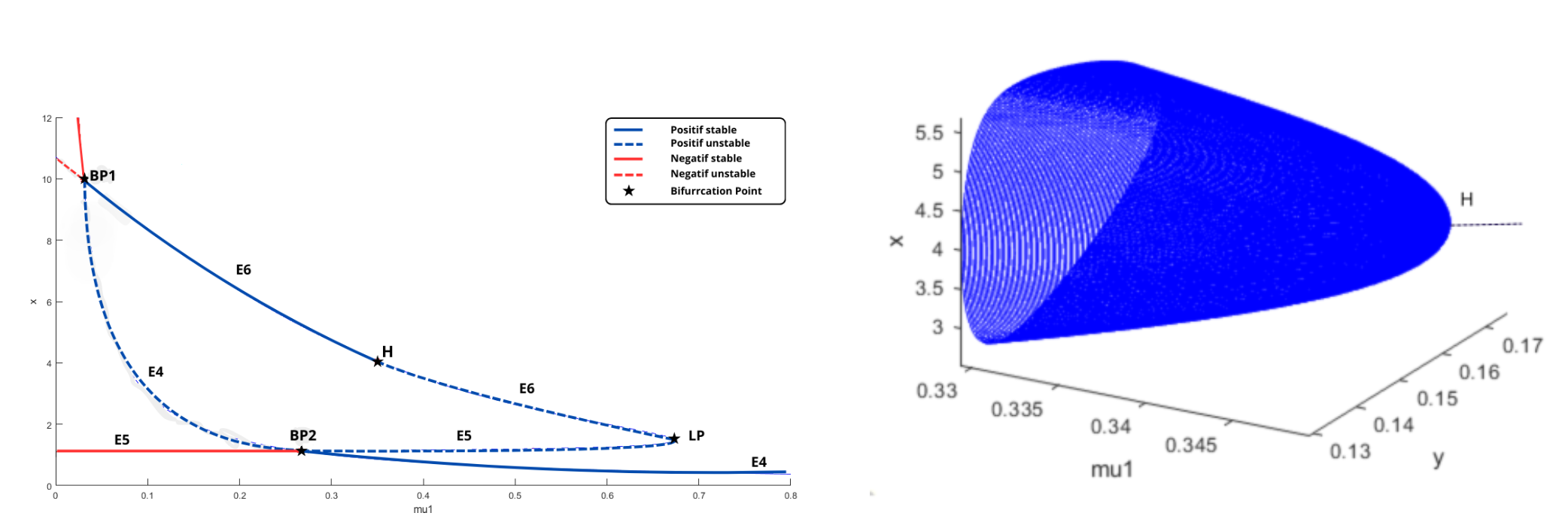
Predator-prey interactions involving 3 species in an African forest ecosystem between Deer, Hyena and Lion considering the influence of kleptoparasitism and anti-predator behaviour using Holling type I $\&$ II functional responses. This predator prey model is constructed based on the assumption that the behaviour of the second predator Hyena often has the ability to defend itself against other predators such as fleeing, fighting, and intimidating which is called anti-predator behaviour. Based on the existing phenonema, the objectives of this study are to determine the model construction, equilibrium point analysis and stability, as well as numerical simulation and interpretation of the prey-prey model using Holling type I $\&$ II functional responses in the presence of kleptoparasitism and anti-predator behaviour. The calculation analysis in this study was carried out by finding the equilibrium point and stability analysis. The results of the dynamic analysis show that there are five equilibrium points with the type of stability, namely $E_1(x, y, z) = (0, 0, 0)$ which states the extinction of the three populations, point equilibrium $E_2(x, y, z) = (K, 0, 0)$ which represents the extinction of the first predator and second predator populations, point equilibrium $E_3(x, y, z)$ $=$ $\left(-\frac{\theta_2}{\theta_2b-\mu_2},0,-\frac{r\mu_2(K(\beta\theta_2-\mu_2)+\theta_2)}{K\beta_2(b\theta_2-\mu)^2}\right)$ which expresses extinction in the first predator population, point equilibrium $E_4(x,y,z) = \left(\frac{\theta_1}{\mu_1},\frac{r(\mu_1K-\theta_1)}{\mu_1K\beta_1},0\right)$ which expresses extinction at the second predator, and equilibrium point $E_5(x^*,y^*,z^*)$ which states that all three populations can coexist. Numerical simulation results show the existence of double stability at points $E_4$ and $E_6$ when the parameter values $\mu_1 = 0.3, \mu_2 = 0.12$ and double stability occurs again at points $E_4$ and $E_3$ when the parameter variation values $\mu_1 = 0.3, \mu_2 = 0.158$.
Article Details

This work is licensed under a Creative Commons Attribution-NonCommercial 4.0 International License.
References
[1] Darmayani S, Hidana R, Latumahina FS, Nendissa SJ, Situmorang MV, Juniatmoko R, et al. Ekologi, Lingkungan Hidup dan Pembangunan. Paper Knowledge Toward a Media History of Documents. 2021:1-291.
[2] Din Q. Stability, bifurcation analysis and chaos control for a predator-prey system. JVC/Journal of Vibration and Control. 2019;25(3):612-26. doi:10.1177/1077546318790871.
[3] Sekar R, Sari FA. Interaksi Tak Terlihat Menguak Mutualisme, Komensalisme Dan Parasitisme Dalam Kehidupan Tumbuhan. Jurnal Sains Student Research (JSSR). 2025;3(4):1076-83. doi:https://doi.org/10.61722/jssr.v3i4.6070.
[4] Adrianto H. Buku Ajar Parasitologi Buku Pegangan Kuliah Mahasiswa Biologi Dan Pendidikan Biologi. Penerbit Andi; 2020.
[5] Padmakumar V, Shanthakumar M. The costs and benefits of kleptoparasitism in frigatebirds: An integrative review. International Journal of Forest, Animal And Fisheries Research. 2023;7(2):01-4. doi:10.22161/ijfaf.7.2.1.
[6] Wood KA, Stillman RA, Goss-Custard JD. The effect of kleptoparasite and host numbers on the risk of food-stealing in an avian assemblage. Journal of Avian Biology. 2015;46(6):589-96. doi:10.1111/jav.00705.
[7] Hadjichrysanthou C, Broom M, Rychtáˇr J. Models of kleptoparasitism on networks: the effect of population structure on food stealing behaviour. Journal of Mathematical Biology. 2018;76(6):1465-88. doi:10.1007/s00285-017-1177-7.
[8] Morand-Ferron J, Sol D, Lefebvre L. Food stealing in birds: brain or brawn? Animal Behaviour. 2007;74(6):1725-34. doi:10.1016/j.anbehav.2007.04.031.
[9] Iyengar EV. Kleptoparasitic interactions throughout the animal kingdom and a re-evaluation, based on participant mobility, of the conditions promoting the evolution of kleptoparasitism. Biological Journal of the Linnean Society. 2008;93(4):745-62. doi:10.1111/j.1095-8312.2008.00954.x.
[10] Bhattacharjee D, Das D, Acharjee S, Dutta TK. Two predators, one prey model that integrates the effect of supplemen- tary food resources due to one predator’s kleptoparasitism under the possibility of retribution by the other predator. Heliyon. 2024;10(7). doi:10.1016/j.heliyon.2024.e28940.
[11] Carbone C, Frame L, Frame G, Malcolm J, Fanshawe J, FitzGibbon C, et al. Feeding success of African wild dogs (Lycaon pictus) in the Serengeti: The effects of group size and kleptoparasitism. Journal of Zoology. 2005;266(2):153-61. doi:10.1017/S0952836905006710.
[12] Källander H. Food hoarding and use of stored food by Rooks Corvus frugilegus. Bird Study. 2007;54(2):192-8. doi:10.1080/00063650709461475.
[13] Reader T. Strong interactions between species of phytophagous fly: A case of intraguild kleptoparasitism. Oikos. 2003;103(1):101-12. doi:10.1034/j.1600-0706.2003.12575.x.
[14] Martišová M, Bilde T, Pekár S. Sex-specific kleptoparasitic foraging in ant-eating spiders. Animal Behaviour. 2009;78(5):1115-8. doi:10.1016/j.anbehav.2009.07.025.
[15] Holling CS. Some Characteristics of Simple Types of Predation and Parasitism. The Canadian Entomologist. 1959;91(7):385-98. doi:10.4039/Ent91385-7.
[16] Mortoja SG, Panja P, Mondal SK. Dynamics of a predator-prey model with stage-structure on both species and anti- predator behavior. Informatics in Medicine Unlocked. 2018;10:50-7. doi:10.1016/j.imu.2017.12.004.
[17] Dawes JHP, Souza MO. A derivation of Holling’s type I, II and III functional responses in predator-prey systems. Journal of Theoretical Biology. 2013;327:11-22. doi:10.1016/j.jtbi.2013.02.017.
[18] Goulart VDLR, Young RJ. Selfish behaviour as an antipredator response in schooling fish? Animal Behaviour. 2013;86(2):443-50. doi:10.1016/j.anbehav.2013.05.041.
[19] Holekamp KE, Smale L, Berg R, Cooper SM. Hunting rates and hunting success in the spotted hyena (Crocuta crocuta). Journal of Zoology. 1997;242(1):1-15. doi:10.1111/j.1469-7998.1997.tb02925.x.
[20] Smith JE, Memenis SK, Holekamp KE. Rank-related partner choice in the fission-fusion society of the spotted hyena (Crocuta crocuta). Behavioral Ecology and Sociobiology. 2007;61(5):753-65. doi:10.1007/s00265-006-0305-y.
[21] Höner OP, Wachter B, East ML, Hofer H. The response of spotted hyaenas to long-term changes in prey pop- ulations: Functional response and interspecific kleptoparasitism. Journal of Animal Ecology. 2002;71(2):236-46. doi:10.1046/j.1365-2656.2002.00596.x.
[22] Packer C, Scheel D, Pusey AE. Why lions form groups: food is not enough. American Naturalist. 1990;136(1):1-19. doi:10.1086/285079.
[23] Tang B, Xiao Y. Bifurcation analysis of a predator–prey model with anti-predator behaviour. Chaos, Solitons & Fractals. 2015 jan;70:58-68. doi:10.1016/j.chaos.2014.11.008.
[24] Mukherjee D. Stability and bifurcation of a two competing prey-one predator system with anti-predator behavior. Jambura Journal of Biomathematics. 2022 jun;3(1):1-11. doi:10.34312/jjbm.v3i1.13820.
[25] Savitri D, Panigoro H. Bifurkasi Hopf pada model prey-predator-super predator dengan fungsi respon yang berbeda. Jambura Journal of Biomathematics. 2020 dec;1(2):65-70. doi:10.34312/jjbm.v1i2.8399.
[26] Salsabila AN, Savitri D. Dynamical Analysis of Holling Tanner Prey Predators Model with Add Food in Second Level Predators. Jambura Journal of Biomathematics. 2024;5(2):63-70. doi:10.37905/jjbm.v5i2.25753.
[27] Focardi S, Materassi M, Innocenti G, Berzi D. Kleptoparasitism and scavenging can stabilize ecosystem dynamics. American Naturalist. 2017;190(3):398-409. doi:10.1086/692798.