
Bibliometric Analysis Of Machine Learning Applications In EEG For Epileptic Seizure Diagnosis Using Biblioshiny: Trends And Conceptual Structures
Article Sidebar
Main Article Content
 https://orcid.org/0000-0003-0819-4922
Abstract
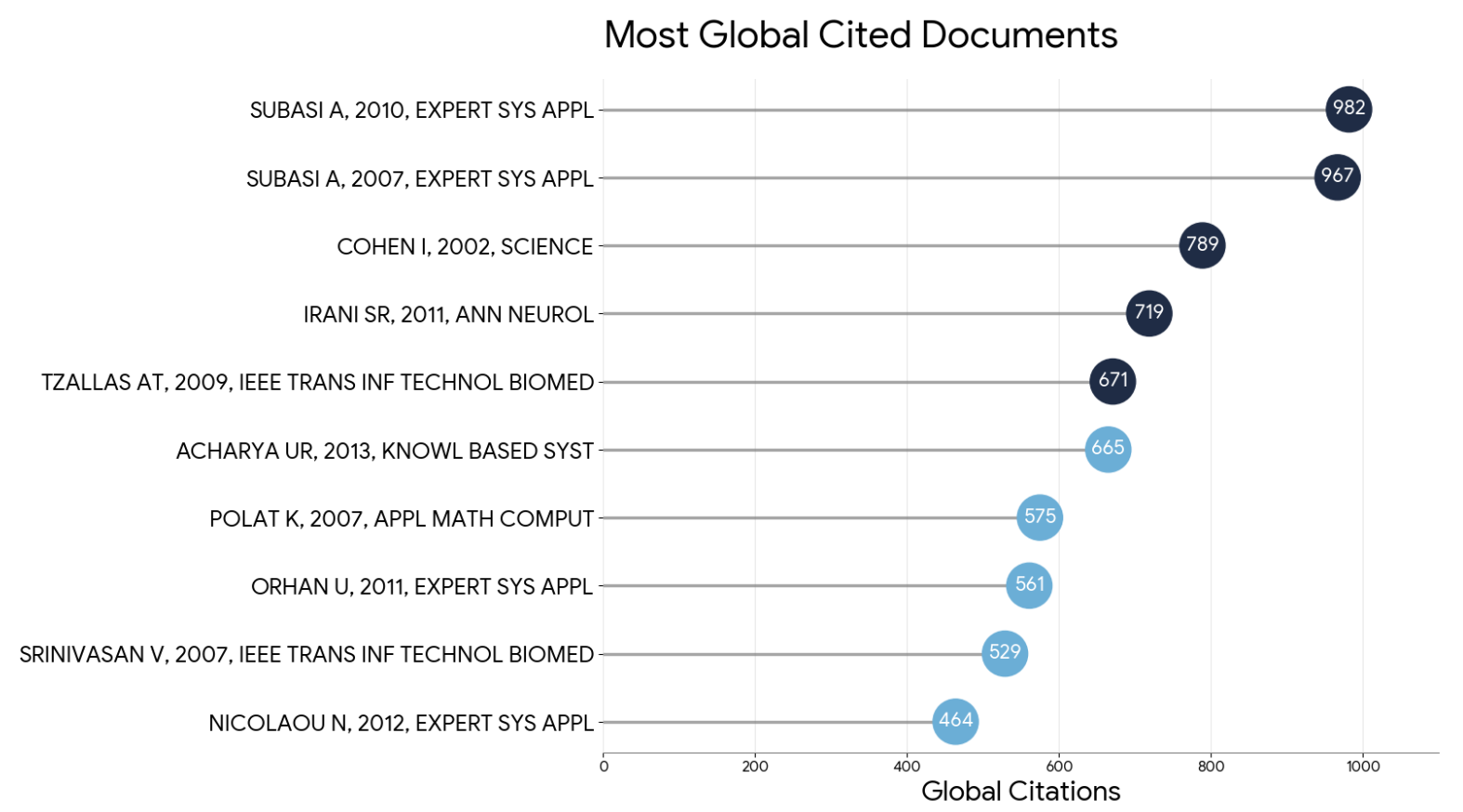
This study examines the research landscape of machine learning applications in EEG-based epileptic seizure diagnosis through bibliometric analysis. A total of 2,805 Scopus-indexed publications (1967--2024) authored by 9,003 researchers were analysed using Biblioshiny in R-Studio to explore publication trends, influential works, collaboration networks, and thematic developments. The analysis reveals a steady annual growth rate of $1.91\%$, with a significant increase in research activity after 2015 driven by advancements in deep learning techniques. While the field benefits from an average of 5.4 co-authors per document, international collaboration remains modest at $26.2\%$ of the total output. Support vector machines (SVMs), artificial neural networks (ANNs), and convolutional neural networks (CNNs) are widely used for seizure detection. However, challenges remain, including limited dataset diversity, real-world implementation barriers, and computational demands. The study finds that research output is concentrated among a few highly cited authors and journals, with fewer contributions from resource-limited regions. The findings indicate a need for broader collaborations, diverse datasets, and evaluation metrics that reflect clinical relevance rather than solely technical performance. Future research should explore explainable AI (XAI), wearable EEG technologies, and practical machine learning integration in clinical settings to improve accessibility and reliability. Addressing these challenges can enhance the impact of machine learning in EEG-based epilepsy diagnosis, leading to better patient outcomes. This bibliometric study provides a detailed, quantified overview of the field's progress, offering insights that can guide future research towards greater inclusivity, collaboration, and real-world applicability.
Article Details

This work is licensed under a Creative Commons Attribution-NonCommercial 4.0 International License.
References
[1] Collaborators GE. Global, regional, and national burden of epilepsy, 1990–2021: a systematic analy- sis for the Global Burden of Disease Study 2021. The Lancet Public Health. 2025 mar;10(3):e203-27. doi:10.1016/S2468-2667(24)00302-5.
[2] Ahmad I, Zhu M, Li G, Javeed D, Kumar P, Chen S. A Secure and Interpretable AI for Smart Healthcare System: A Case Study on Epilepsy Diagnosis Using EEG Signals. IEEE Journal of Biomedical and Health Informatics. 2024;28(6):3236-47. doi:10.1109/JBHI.2024.3366341.
[3] Sharmila A. Epilepsy detection from EEG signals: a review. Journal of Medical Engineering and Technol- ogy. 2018;42(5):368-80. doi:10.1080/03091902.2018.1513576.
[4] Supriya S, Siuly S, Wang H, Zhang Y. Automated epilepsy detection techniques from electroencephalogram signals: a review study. Health Information Science and Systems. 2020 oct;8(1):33. doi:10.1007/s13755- 020-00129-1.
[5] Kleen JK, Guterman EL. The New Era of Automated Electroencephalogram Interpretation. JAMA Neurol- ogy. 2023;80(8):777-8. doi:10.1001/jamaneurol.2023.1082.
[6] Si Y. Machine learning applications for electroencephalograph signals in epilepsy: A quick review. Acta Epileptologica. 2020 apr;2(1):5. doi:10.1186/s42494-020-00014-0.
[7] Dastgoshadeh M, Rabiei Z. Detection of epileptic seizures through EEG signals using entropy features and ensemble learning. Frontiers in Human Neuroscience. 2023;16. doi:10.3389/fnhum.2022.1084061.
[8] Rasheed K, Qayyum A, Qadir J, Sivathamboo S, Kwan P, Kuhlmann L, et al. Machine Learning for Predicting Epileptic Seizures Using EEG Signals: A Review. IEEE Reviews in Biomedical Engineering. 2021;14:139-55. doi:10.1109/RBME.2020.3008792.
[9] Statsenko Y, Babushkin V, Talako T, Kurbatova T, Smetanina D, Simiyu GL, et al. Automatic Detection and Classification of Epileptic Seizures from EEG Data: Finding Optimal Acquisition Settings and Testing Inter- pretable Machine Learning Approach. Biomedicines. 2023;11(9). doi:10.3390/biomedicines11092370.
[10] Alsolbi I, Wu M, Zhang Y, Joshi S, Sharma M, Tafavogh S, et al. Different approaches of bibliometric analysis for data analytics applications in non-profit organisations. Journal of Smart Environments and Green Computing. 2022 jan;2(3):90-104. doi:10.20517/jsegc.2022.09.
[11] Gramacki A, Gramacki J. A deep learning framework for epileptic seizure detection based on neonatal EEG signals. Scientific Reports. 2022 jul;12(1):13010. doi:10.1038/s41598-022-15830-2.
[12] Mirowski PW, LeCun Y, Madhavan D, Kuzniecky R. Comparing SVM and convolutional networks for epileptic seizure prediction from intracranial EEG. In: Proceedings of the 2008 IEEE Workshop on Machine Learning for Signal Processing, MLSP 2008; 2008. p. 244-9. doi:10.1109/MLSP.2008.4685487.
[13] Acharya UR, Vinitha Sree S, Swapna G, Martis RJ, Suri JS. Automated EEG analysis of epilepsy: A review. Knowledge-Based Systems. 2013;45:147-65. doi:10.1016/j.knosys.2013.02.014.
[14] Roy Y, Banville H, Albuquerque I, Gramfort A, Falk TH, Faubert J. Deep learning-based electroen- cephalography analysis: A systematic review. Journal of Neural Engineering. 2019 aug;16(5):51001. doi:10.1088/1741-2552/ab260c.
[15] Tsiouris Iˆ, Pezoulas VC, Zervakis M, Konitsiotis S, Koutsouris DD, Fotiadis DI. A Long Short-Term Memory deep learning network for the prediction of epileptic seizures using EEG signals. Computers in Biology and Medicine. 2018;99:24-37. doi:10.1016/j.compbiomed.2018.05.019.
[16] Birjandtalab J, Baran Pouyan M, Cogan D, Nourani M, Harvey J. Automated seizure detection us- ing limited-channel EEG and non-linear dimension reduction. Computers in Biology and Medicine. 2017;82:49-58. doi:10.1016/j.compbiomed.2017.01.011.
[17] Antoniades A, Spyrou L, Took CC, Sanei S. Deep learning for epileptic intracranial EEG data. In: IEEE International Workshop on Machine Learning for Signal Processing, MLSP. vol. 2016-November; 2016. p. 1-6. doi:10.1109/MLSP.2016.7738824.
[18] Faust O, Hagiwara Y, Hong TJ, Lih OS, Acharya UR. Deep learning for healthcare applications based on physiological signals: A review. Computer Methods and Programs in Biomedicine. 2018;161:1-13. doi:10.1016/j.cmpb.2018.04.005.
[19] Mormann F, Andrzejak RG. Seizure prediction: Making mileage on the long and winding road. Brain. 2016;139(6):1625-7. doi:10.1093/brain/aww091.
[20] Acharya UR, Oh SL, Hagiwara Y, Tan JH, Adeli H. Deep convolutional neural network for the automated detection and diagnosis of seizure using EEG signals. Computers in Biology and Medicine. 2018;100:270-
8. doi:10.1016/j.compbiomed.2017.09.017.
[21] Craik A, He Y, Contreras-Vidal JL. Deep learning for electroencephalogram (EEG) classification tasks: A review. Journal of Neural Engineering. 2019 apr;16(3):31001. doi:10.1088/1741-2552/ab0ab5.
[22] Sharan RV, Berkovsky S. Epileptic Seizure Detection Using Multi-Channel EEG Wavelet Power Spec- tra and 1-D Convolutional Neural Networks. In: Proceedings of the Annual International Confer- ence of the IEEE Engineering in Medicine and Biology Society, EMBS. vol. 2020-July; 2020. p. 545-8. doi:10.1109/EMBC44109.2020.9176243.
[23] Islam MK, Rastegarnia A, Yang Z. Les méthodes de détection et de rejet d’artefact de l’EEG de scalp : revue de littérature. Neurophysiologie Clinique. 2016;46(4-5):287-305. doi:10.1016/j.neucli.2016.07.002.
[24] Zupic I, Cˇater T. Bibliometric Methods in Management and Organization. Organizational Research Methods. 2015;18(3):429-72. doi:10.1177/1094428114562629.
[25] Boyack KW, Klavans R. Creation of a highly detailed, dynamic, global model and map of science. Journal of the Association for Information Science and Technology. 2014;65(4):670-85. doi:10.1002/asi.22990.
[26] Subasi A. EEG signal classification using wavelet feature extraction and a mixture of expert model. Expert Systems with Applications. 2007;32(4):1084-93. doi:10.1016/j.eswa.2006.02.005.
[27] Subasi A, Gursoy MI. EEG signal classification using PCA, ICA, LDA and support vector machines. Expert Systems with Applications. 2010;37(12):8659-66. doi:10.1016/j.eswa.2010.06.065.
[28] Cohen I, Navarro V, Clemenceau S, Baulac M, Miles R. On the origin of interictal activity in human temporal lobe epilepsy in vitro. Science. 2002 nov;298(5597):1418-21. doi:10.1126/science.1076510.
[29] Tzallas AT, Tsipouras MG, Fotiadis DI. Epileptic seizure detection in EEGs using time-frequency analysis. IEEE Transactions on Information Technology in Biomedicine. 2009;13(5):703-10. doi:10.1109/TITB.2009.2017939.
[30] Irani SR, Michell AW, Lang B, Pettingill P, Waters P, Johnson MR, et al. Faciobrachial dys- tonic seizures precede Lgi1 antibody limbic encephalitis. Annals of Neurology. 2011;69(5):892-900. doi:10.1002/ana.22307.
[31] Truong ND, Nguyen AD, Kuhlmann L, Bonyadi MR, Yang J, Ippolito S, et al. Convolutional neural networks for seizure prediction using intracranial and scalp electroencephalogram. Neural Networks. 2018;105:104-11. doi:10.1016/j.neunet.2018.04.018.
[32] Shoeb A, Guttag J. Application of machine learning to epileptic seizure detection. Massachusetts Institute of Technology; 2010.
[33] Faust O, Acharya UR, Adeli H, Adeli A. Wavelet-based EEG processing for computer-aided seizure detection and epilepsy diagnosis. Seizure. 2015;26:56-64. doi:10.1016/j.seizure.2015.01.012.
[34] Mormann F, Andrzejak RG, Elger CE, Lehnertz K. Seizure prediction: The long and winding road. Brain. 2007;130(2):314-33. doi:10.1093/brain/awl241.
[35] Abadi HHN, He Z, Pecht M. Artificial intelligence-related research funding by the u.s. national sci- ence foundation and the national natural science foundation of china. IEEE Access. 2020;8:183448-59. doi:10.1109/ACCESS.2020.3029231.
[36] Bazavan A, Huidumac-Petrescu CE. China’s Drive for Technological Leadership in Artificial Intelligence. Key Policies and Government-Industry Integration. In: Busu M, editor. Springer Proceedings in Business and Economics. Cham: Springer Nature Switzerland; 2023. p. 17-30. doi:10.1007/978-3-031-19886-1_2.
[37] Guleria S, Guptill J, Kumar I, McClintic M, Rojas JC. Artificial intelligence integration in healthcare: perspectives and trends in a survey of U.S. health system leaders. BMC Digital Health. 2024 nov;2(1):80. doi:10.1186/s44247-024-00135-3.
[38] Kunekar P, Gupta MK, Gaur P. Detection of epileptic seizure in EEG signals using machine learn- ing and deep learning techniques. Journal of Engineering and Applied Science. 2024 jan;71(1):21. doi:10.1186/s44147-023-00353-y.
[39] Handa P, Lavanya, Goel N, Garg N. Software advancements in automatic epilepsy diagnosis and seizure detection: 10-year review. Artificial Intelligence Review. 2024 jun;57(7):181. doi:10.1007/s10462-024- 10799-y.
[40] Rehab N, Siwar Y, Mourad Z. Machine Learning for Epilepsy: A Comprehensive Exploration of Novel EEG and MRI Techniques for Seizure Diagnosis. Journal of Medical and Biological Engineering. 2024 jun;44(3):317-36. doi:10.1007/s40846-024-00874-8.
[41] Kerr WT, McFarlane KN. Machine Learning and Artificial Intelligence Applications to Epilepsy: a Review for the Practicing Epileptologist. Current Neurology and Neuroscience Reports. 2023 dec;23(12):869-79. doi:10.1007/s11910-023-01318-7.
[42] Hart KL, Perlis RH. Authorship inequality: A bibliometric study of the concentration of authorship among a diminishing number of individuals in high-impact medical journals, 2008-2019. BMJ Open. 2021;11(1). doi:10.1136/bmjopen-2020-046002.
[43] Kahn K, Ryan G, Beckett M, Taylor S, Berrebi C, Cho M, et al. Bridging the gap between basic sci- ence and clinical practice: A role for community clinicians. Implementation Science. 2011 apr;6(1):34. doi:10.1186/1748-5908-6-34.
[44] Beckett M, Quiter E, Ryan G, Berrebi C, Taylor S, Cho M, et al. Bridging the gap between basic science and clinical practice: The role of organizations in addressing clinician barriers. Implementation Science. 2011 apr;6(1):35. doi:10.1186/1748-5908-6-35.
[45] Costas R, Bordons M. The h-index: Advantages, limitations and its relation with other bibliometric indi- cators at the micro level. Journal of Informetrics. 2007;1(3):193-203. doi:10.1016/j.joi.2007.02.001.
[46] Vayena E, Blasimme A, Cohen IG. Machine learning in medicine: Addressing ethical challenges. PLoS Medicine. 2018;15(11):1-4. doi:10.1371/journal.pmed.1002689.
[47] Khosravi M, Zare Z, Mojtabaeian SM, Izadi R. Ethical challenges of using artificial intelligence in health-care delivery: a thematic analysis of a systematic review of reviews. Journal of Public Health (Germany). 2025 feb;33(11):2485-95. doi:10.1007/s10389-024-02219-w.
[48] Scott IA, Van Der Vegt A, Lane P, McPhail S, Magrabi F. Achieving large-scale clinician adoption of AI- enabled decision support. BMJ Health and Care Informatics. 2024 may;31(1). doi:10.1136/bmjhci-2023- 100971.
[49] Balagopalan A, Baldini I, Celi LA, Gichoya J, McCoy LG, Naumann T, et al. Machine learning for healthcare that matters: Reorienting from technical novelty to equitable impact. PLOS Digital Health. 2024;3(4):1-22. doi:10.1371/journal.pdig.0000474.
[50] Pellinen J. Treatment gaps in epilepsy. Frontiers in Epidemiology. 2022;2. doi:10.3389/fepid.2022.976039.
[51] Deprez D, Busch AJ, Ramirez PA, Pedrozo Araque E, Bidonde J. Capacity-building and continuing pro- fessional development in healthcare and rehabilitation in low- and middle-income countries—a scoping review protocol. Systematic Reviews. 2023 feb;12(1):22. doi:10.1186/s13643-023-02188-3.
[52] Giebel C, Gabbay M, Shrestha N, Saldarriaga G, Reilly S, White R, et al. Community-based mental health interventions in low- and middle-income countries: a qualitative study with international experts. Inter- national Journal for Equity in Health. 2024 feb;23(1):19. doi:10.1186/s12939-024-02106-6.
[53] Diggs-Andrews KA, Mayer DCG, Riggs B. Introduction to effective mentorship for early-career research scientists. BMC Proceedings. 2021 jun;15(2):7. doi:10.1186/s12919-021-00212-9.
[54] Thakar MS, Rubio DM, Murrell AJ, Morone NE, Mitchell Miland C, White GE. The impact of inclu- sive mentoring and identity work on self-efficacy in career advancement and career commitment among underrepresented early-career faculty and post-doctoral fellows. Journal of Clinical and Translational Science. 2024;8(1):e61. doi:10.1017/cts.2024.504.
[55] Fabris A, Messina S, Silvello G, Susto GA. Algorithmic fairness datasets: the story so far. Data Mining and Knowledge Discovery. 2022 nov;36(6):2074-152. doi:10.1007/s10618-022-00854-z.
[56] Pagano TP, Loureiro RB, Lisboa FVN, Peixoto RM, Guimarães GAS, Cruz GOR, et al. Bias and Unfairness in Machine Learning Models: A Systematic Review on Datasets, Tools, Fairness Metrics, and Identification and Mitigation Methods. Big Data and Cognitive Computing. 2023;7(1). doi:10.3390/bdcc7010015.
[57] Chang RSK, Nguyen S, Chen Z, Foster E, Kwan P. Role of machine learning in the management of epilepsy: a systematic review protocol. BMJ Open. 2024;14(1). doi:10.1136/bmjopen-2023-079785.
[58] Weissler EH, Naumann T, Andersson T, Ranganath R, Elemento O, Luo Y, et al. The role of machine learning in clinical research: transforming the future of evidence generation. Trials. 2021 aug;22(1):537. doi:10.1186/s13063-021-05489-x.
[59] Vasey B, Nagendran M, Campbell B, Clifton DA, Collins GS, Denaxas S, et al. Reporting guideline for the early stage clinical evaluation of decision support systems driven by artificial intelligence: DECIDE-AI. Bmj. 2023;377. doi:10.1136/bmj-2022-070904.
[60] Vollmer S, Mateen BA, Bohner G, Király FJ, Ghani R, Jonsson P, et al. Machine learning and artificial intelligence research for patient benefit: 20 critical questions on transparency, replicability, ethics, and effectiveness. The BMJ. 2020;368:l6927. doi:10.1136/bmj.l6927.
[61] Mori H, Nakayama T. Academic Impact of Qualitative Studies in Healthcare: Bibliometric Analysis. PLoS ONE. 2013;8(3):1-7. doi:10.1371/journal.pone.0057371.
[62] Sumathipala A, Siribaddana S, Patel V. Under-representation of developing countries in the research literature: Ethical issues arising from a survey of five leading medical journals. BMC Medical Ethics. 2004 oct;5(1):5. doi:10.1186/1472-6939-5-5.
[63] Aksnes DW, Schneider JW, Gunnarsson M. Ranking national research systems by citation indicators. A comparative analysis using whole and fractionalised counting methods. Journal of Informetrics. 2012;6(1):36-43. doi:10.1016/j.joi.2011.08.002.
[64] O’Cathain A, Murphy E, Nicholl J. Three techniques for integrating data in mixed methods studies. BMJ (Online). 2010;341(7783):1147-50. doi:10.1136/bmj.c4587.
[65] Haustein S, Larivière V. The Use of Bibliometrics for Assessing Research: Possibilities, Limitations and Adverse Effects. In: Incentives and Performance. Cham: Springer International Publishing; 2015. p. 121-39. doi:10.1007/978-3-319-09785-5_8.
[66] Cobelli N, Blasi S. Combining topic modeling and bibliometric analysis to understand the evolution of technological innovation adoption in the healthcare industry. European Journal of Innovation Manage- ment. 2024 jan;27(9):127-49. doi:10.1108/EJIM-06-2023-0497.
[67] Raab D, Theissler A, Spiliopoulou M. XAI4EEG: spectral and spatio-temporal explanation of deep learning-based seizure detection in EEG time series. Neural Computing and Applications. 2023 may;35(14):10051-68. doi:10.1007/s00521-022-07809-x.
[68] Joyner M, Hsu SH, Martin S, Dwyer J, Chen DF, Sameni R, et al. Using a standalone ear-EEG device for focal-onset seizure detection. Bioelectronic Medicine. 2024;10(1):4. doi:10.1186/s42234-023-00135-0.