
Mathematical Modeling of COVID-19: An Optimal Control Approach
Article Sidebar
Main Article Content
 https://orcid.org/0000-0001-5161-7287
Abstract
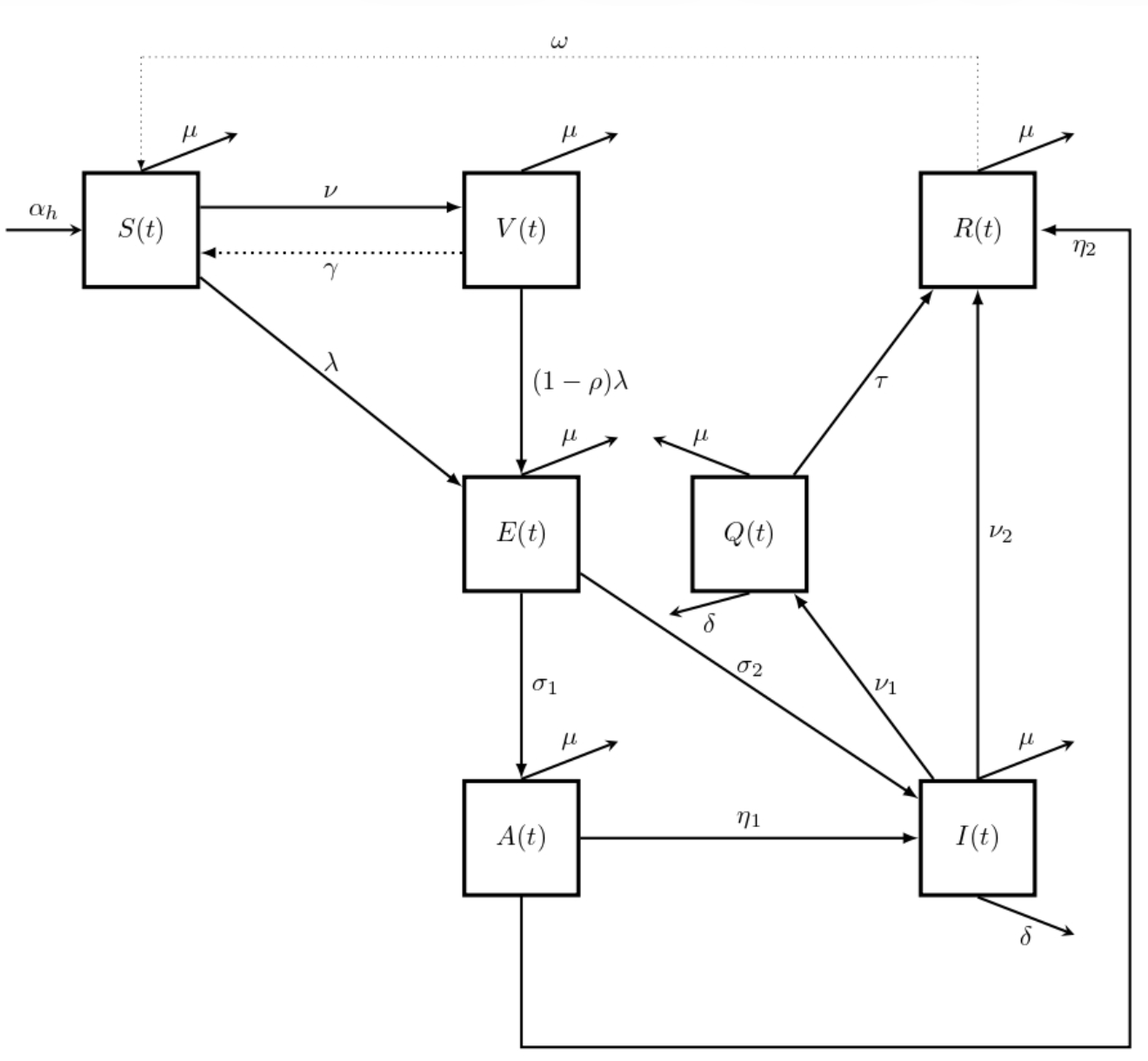
A non-linear mathematical model is developed to describe the transmission dynamics of COVID-19. The model’s well-posedness is verified by analyzing the positivity and boundedness of its solutions. Analytical expressions for the disease-free equilibrium points are derived and the stability analyses of the disease-free and endemic equilibrium points are conducted. A sensitivity analysis of the model parameters with respect to the basic reproduction number (R0) is carried out to identify the key factors influencing COVID-19 transmission. Consequently, the model is extended into an optimal control problem by incorporating three time-dependent interventions: preventive measures (such as travel restrictions and personal protection), continuous vaccination of susceptible individuals, and testing, isolation, and treatment of infected cases. Four control strategies, each combining at least two interventions, are explored. The autonomous and non-autonomous systems are analyzed. Numerical simulations indicate that implementing the three control measures concurrently provides the most effective strategy to mitigating the spread of COVID-19.
Article Details

This work is licensed under a Creative Commons Attribution-NonCommercial 4.0 International License.
References
[1] Yusuf TT, Abidemi A, Afolabi AS, Dansu EJ. Optimal Control of the Coronavirus Pandemic with Impacts of Implemented Control Measures. Journal of the Nigerian Society of Physical Sciences. 2022;4(1):88-98. doi:10.46481/jnsps.2022.414.
[2] Abioye AI, Peter OJ, Ogunseye HA, Oguntolu FA, Oshinubi K, Ibrahim AA, et al. Mathematical model of COVID-19 in Nigeria with optimal control. Results in Physics. 2021;28:104598. doi:10.1016/j.rinp.2021.104598.
[3] Joshua EE, Akpan ET, Inyang UG. Computational Nonlinear Dynamics: Analysis and Assessment in Optimal Control of COVID-19 in Akwa Ibom State, Nigeria. Journal of Advances in Mathematics and Computer Science. 2024;39(1):1-19. doi:10.9734/jamcs/2024/v39i11858.
[4] Okuonghae D, Omame A. Analysis of a mathematical model for COVID-19 population dynamics in Lagos, Nigeria. Chaos, Solitons and Fractals. 2020;139:110032. doi:10.1016/j.chaos.2020.110032.
[5] World Health Organization. COVID-19 epidemiological update – 15 March 2024. Https://WwwWhoInt/Publications/M/Item/Covid- 19-Epidemiological-Update-15-March-2024. 2024;(March):2-3.
[6] Ayoola TA, Kolawole MK, Popoola AO. Effects of Acceptance of Enlightenment on COVID-19 Transmission using Homotopy Perturbation Method. Jambura Journal of Biomathematics. 2022 dec;3(2):39-48. doi:10.34312/jjbm.v3i2.15798.
[7] Akanni JO, Abidemi A, Fatmawati F, Chukwu CW. A Non-linear Fractional Model for Analyzing the Impact of Vaccination on the Dynamics of COVID-19 in Indonesia. Jambura Journal of Biomathematics. 2025;6(2):109-28. doi:10.37905/jjbm.v6i2.30383.
[8] Sihaloho RSBR, Nasution H. Dynamic analysis of SEIR model for Covid-19 spread in Medan. Jambura Journal of Biomathematics. 2022 dec;3(2):68-72. doi:10.34312/jjbm.v3i2.16878.
[9] Putri NQ, Sianturi P, Sumarno H. Mathematical model of Dynamics of Covid-19 Transmission in Response to Reinfection. Jambura Journal of Biomathematics. 2023 apr;4(1):15-22. doi:10.34312/jjbm.v4i1.18394.
[10] Kamalia PZ, Aldila D. Epidemic Dynamics with Nonlinear Incidence Considering Vaccination Effectiveness. Jambura Journal of Biomathematics. 2025;6(3):222-33. doi:10.37905/jjbm.v6i3.33815.
[11] Acuña-Zegarra MA, Díaz-Infante S, Baca-Carrasco D, Olmos-Liceaga D. COVID-19 optimal vaccination policies: A modeling study on efficacy, natural and vaccine-induced immunity responses. Mathematical Biosciences. 2021;337:108614. doi:10.1016/j.mbs.2021.108614.
[12] Adiga A, Dubhashi D, Lewis B, Marathe M, Venkatramanan S, Vullikanti A. Mathematical Models for COVID-19 Pandemic: A Comparative Analysis. Journal of the Indian Institute of Science. 2020;100(4):793-807. doi:10.1007/s41745-020-00200-6.
[13] Djidjou-Demasse R, Michalakis Y, Choisy M, Sofonea MT, Alizon S. Optimal COVID-19 epidemic control until vaccine deployment. medRxiv. 2020:2020.04.02.20049189. doi:10.1101/2020.04.02.20049189.
[14] Gumel AB, Iboi EA, Ngonghala CN, Elbasha EH. A primer on using mathematics to understand COVID-19 dynamics: Modeling, analysis and simulations. Infectious Disease Modelling. 2021;6:148-68. doi:10.1016/j.idm.2020.11.005.
[15] Lü X, wen Hui H, fei Liu F, li Bai Y. Stability and optimal control strategies for a novel epidemic model of COVID-19. Nonlinear Dynamics. 2021;106(2):1491-507. doi:10.1007/s11071-021-06524-x.
[16] Ojo MM, Benson TO, Peter OJ, Goufo EFD. Nonlinear optimal control strategies for a mathematical model of COVID-19 and influenza co-infection. Physica A: Statistical Mechanics and its Applications. 2022;607:128173. doi:10.1016/j.physa.2022.128173.
[17] Omame A, Nwajeri UK, Abbas M, Onyenegecha CP. A fractional order control model for Diabetes and COVID-19 co-dynamics with Mittag-Leffler function. Alexandria Engineering Journal. 2022;61(10):7619-35. doi:10.1016/j.aej.2022.01.012.
[18] Tchoumi SY, Diagne ML, Rwezaura H, Tchuenche JM. Malaria and COVID-19 co-dynamics: A mathematical model and optimal control. Applied Mathematical Modelling. 2021;99:294-327. doi:10.1016/j.apm.2021.06.016.
[19] World Health Organization. COVID-19 epidemiological update – 15 March 2024. Https://WwwWhoInt/Publications/M/Item/Covid- 19-Epidemiological-Update-15-March-2024. 2024;(March):2-3.
[20] Adel W, Günerhan H, Nisar KS, Agarwal P, El-Mesady A. Designing a novel fractional order mathematical model for COVID-19 incorporating lockdown measures. Scientific Reports. 2024;14(1):2926. doi:10.1038/s41598-023-50889-5.
[21] Akanni JO, Fatmawati, Ajao S, Asamoah JKK, Abimbade SF. Mathematical model of COVID-19 dynamics in the presence of multiple controls. Quality and Quantity. 2025;59(Suppl 1):261-90. doi:10.1007/s11135-024-01975-x.
[22] Ali M, Imran M, Khan A. Can medication mitigate the need for a strict lock down?: A mathematical study of control strategies for COVID-19 infection. medRxiv. 2020:2020.05.29.20116749. doi:10.1101/2020.05.29.20116749.
[23] Atangana A, I˙g˘ ret Araz S. Mathematical model of COVID-19 spread in Turkey and South Africa: theory, methods, and applications. Advances in Difference Equations. 2020;2020(1):1-89. doi:10.1186/s13662-020-03095-w.
[24] Awasthi A. A mathematical model for transmission dynamics of COVID-19 infection. European Physical Journal Plus. 2023;138(3):285. doi:10.1140/epjp/s13360-023-03866-w.
[25] Burch E, Khan SA, Stone J, Asgharzadeh A, Dawe J, Ward Z, et al. Early mathematical models of COVID-19 vaccination in high-income countries: a systematic review. Public Health. 2024;236:207-15. doi:10.1016/j.puhe.2024.07.029.
[26] Chinebu TI, Okonkwo CU. Modeling the Optimal Control of the Transmission Dynamics of COVID-19 Infection with Quarantine and Isolation. Global Scientific Journal (GSJ). 2021;9(2).
[27] Deressa CT, Duressa GF. Modeling and optimal control analysis of transmission dynamics of COVID-19: The case of Ethiopia. Alexandria Engineering Journal. 2021;60(1):719-32. doi:10.1016/j.aej.2020.10.004.
[28] Din A, Li Y, Khan T, Zaman G. Mathematical analysis of spread and control of the novel corona virus (COVID-19) in China. Chaos, Solitons and Fractals. 2020;141:110286. doi:10.1016/j.chaos.2020.110286.
[29] Du SQ, Yuan W. Mathematical modeling of interaction between innate and adaptive immune responses in COVID-19 and implications for viral pathogenesis. Journal of Medical Virology. 2020;92(9):1615-28. doi:10.1002/jmv.25866.
[30] Kucharski AJ, Russell TW, Diamond C, Liu Y, Edmunds J, Funk S, et al. Early dynamics of transmission and control of COVID-19: a mathematical modelling study. The Lancet Infectious Diseases. 2020;20(5):553-8. doi:10.1016/S1473-3099(20)30144-4.
[31] Li T, Guo Y. Modeling and optimal control of mutated COVID-19 (Delta strain) with imperfect vaccination. Chaos, Solitons and Fractals. 2022;156:111825. doi:10.1016/j.chaos.2022.111825.
[32] Manabe H, Manabe T, Honda Y, Kawade Y, Kambayashi D, Manabe Y, et al. Simple mathematical model for predicting COVID-19 outbreaks in Japan based on epidemic waves with a cyclical trend. BMC Infectious Diseases. 2024;24(1):465. doi:10.1186/s12879-024-09354-5.
[33] Mandal M, Jana S, Nandi SK, Khatua A, Adak S, Kar TK. A model based study on the dynamics of COVID-19: Prediction and control. Chaos, Solitons and Fractals. 2020;136:109889. doi:10.1016/j.chaos.2020.109889.
[34] Morato MM, Bastos SB, Cajueiro DO, Normey-Rico JE. An optimal predictive control strategy for COVID-19 (SARS-CoV-2) social distancing policies in Brazil. Annual Reviews in Control. 2020;50:417-31. doi:10.1016/j.arcontrol.2020.07.001.
[35] Nguyen HK. Application of mathematical models to assess the impact of the covid-19 pandemic on logistics businesses and recovery solutions for sustainable development. Mathematics. 2021;9(16):1977. doi:10.3390/math9161977.
[36] Pinto Neto O, Kennedy DM, Reis JC, Wang Y, Brizzi ACB, Zambrano GJ, et al. Mathematical model of COVID-19 intervention scenarios for São Paulo—Brazil. Nature Communications. 2021;12(1):418. doi:10.1038/s41467-020-20687-y.
[37] Sameni R. Mathematical Modeling of Epidemic Diseases; A Case Study of the COVID-19 Coronavirus. arXiv preprint arXiv:200311371. 2020. doi:10.48550/arXiv.2003.11371.
[38] Shen ZH, Chu YM, Khan MA, Muhammad S, Al-Hartomy OA, Higazy M. Mathematical modeling and optimal control of the COVID-19 dynamics. Results in Physics. 2021;31:105028. doi:10.1016/j.rinp.2021.105028.
[39] Sta˘ncioi CM, S, tefan IA, Briciu V, Mures, an V, Clitan I, Abrudean M, et al. Solution for the Mathematical Modeling and Future Prediction of the COVID-19 Pandemic Dynamics. Applied Sciences (Switzerland). 2023;13(13):7971. doi:10.3390/app13137971.
[40] Tsay C, Lejarza F, Stadtherr MA, Baldea M. Modeling, state estimation, and optimal control for the US COVID-19 outbreak. Scientific Reports. 2020;10(1):10711. doi:10.1038/s41598-020-67459-8.
[41] Ullah S, Khan MA. Modeling the impact of non-pharmaceutical interventions on the dynamics of novel coronavirus with optimal control analysis with a case study. Chaos, Solitons and Fractals. 2020;139:110075. doi:10.1016/j.chaos.2020.110075.
[42] Yousefpour A, Jahanshahi H, Bekiros S. Optimal policies for control of the novel coronavirus disease (COVID-19) outbreak. Chaos, Solitons and Fractals. 2020;136:109883. doi:10.1016/j.chaos.2020.109883.
[43] Zhao S, Chen H. Modeling the epidemic dynamics and control of COVID-19 outbreak in China. Quantitative Biology. 2020;8(1):11-9. doi:10.1007/s40484-020-0199-0.
[44] Nana-Kyere S, Okyere E, Ankamah JDG. Compartmental seirw Covid-19 optimal control model. Communications in Mathematical Biology and Neuroscience. 2020;2020:1-30. doi:10.28919/cmbn/4998.
[45] Madubueze CE, Dachollom S, Onwubuya IO. Controlling the Spread of COVID-19: Optimal Control Analysis. Computational and Mathematical Methods in Medicine. 2020;2020. doi:10.1155/2020/6862516.
[46] Yan X, Zou Y. Optimal and sub-optimal quarantine and isolation control in SARS epidemics. Mathematical and Computer Modelling. 2008;47(1-2):235-45. doi:10.1016/j.mcm.2007.04.003.
[47] Kifle ZS, Lemecha Obsu L. Optimal control analysis of a COVID-19 model. Applied Mathematics in Science and Engineering. 2023;31(1):2173188. doi:10.1080/27690911.2023.2173188.
[48] Omede BI, Odionyenma UB, Ibrahim AA, Bolaji B. Third wave of COVID-19: mathematical model with optimal control strategy for reducing the disease burden in Nigeria. International Journal of Dynamics and Control. 2023;11(1):411-27. doi:10.1007/s40435-022-00982-w.
[49] Khan AA, Ullah S, Amin R. Optimal control analysis of COVID-19 vaccine epidemic model: a case study. European Physical Journal Plus. 2022;137(1):1-25. doi:10.1140/epjp/s13360-022-02365-8.
[50] Butt AIK, Imran M, Chamaleen DBD, Batool S. Optimal control strategies for the reliable and competitive mathematical analysis of Covid-19 pandemic model. Mathematical Methods in the Applied Sciences. 2023;46(2):1528-55. doi:10.1002/mma.8593.
[51] Zamir M, Abdeljawad T, Nadeem F, Wahid A, Yousef A. An optimal control analysis of a COVID-19 model. Alexandria Engineering Journal. 2021;60(3):2875-84. doi:10.1016/j.aej.2021.01.022.
[52] El Bhih A, Benfatah Y, Kouidere A, Rachik M. A discrete mathematical modeling of transmission of Covid-19 pandemic using optimal control. Communications in Mathematical Biology and Neuroscience. 2020;2020:1-23. doi:10.28919/cmbn/4780.
[53] Mondal J, Khajanchi S. Mathematical modeling and optimal intervention strategies of the COVID-19 outbreak. Nonlinear Dynamics. 2022;109(1):177-202. doi:10.1007/s11071-022-07235-7.
[54] Goswami NK, Olaniyi S, Abimbade SF, Chuma FM. A mathematical model for investigating the effect of media awareness programs on the spread of COVID-19 with optimal control. Healthcare Analytics. 2024;5:100300. doi:10.1016/j.health.2024.100300.
[55] Bixler SL, Stefan CP, Jay AN, Rossi FD, Ricks KM, Shoemaker CJ, et al. Exposure Route Influences Disease Severity in the COVID-19 Cynomolgus Macaque Model. Viruses. 2022;14(5):1013. doi:10.3390/v14051013.
[56] Ojo MM, Goufo EFD. Assessing the impact of control interventions and awareness on malaria: A mathematical modeling approach. Communications in Mathematical Biology and Neuroscience. 2021;2021:1-31. doi:10.28919/cmbn/6632.
[57] Chen TM, Rui J, Wang QP, Zhao ZY, Cui JA, Yin L. A mathematical model for simulating the phase-based transmissibility of a novel coronavirus. Infectious Diseases of Poverty. 2020;9(1):18-25. doi:10.1186/s40249-020-00640-3.
[58] World Health Organization (WHO). COVID-19 Weekly Epidemiological Update: Edition 185; 2024. https://www.who.int/publications/m/item/weekly-epidemiological-update-on-covid-19---5-march-2024.
[59] Furtat IB, Others. Generalization of Gershgorin Circle Theorem with Application to Analysis and Design of Control Systems. Avtomatika i telemehanika. 2025;(6):3-23.
[60] Weisstein EW. Gershgorin Circle Theorem; 2003. MathWorld—A Wolfram Web Resource.
[61] Castillo-Chavez C, Thieme HR. Asymptotically autonomous epidemic models. Science. 1994;94(38):1-22.
[62] Castillo-Ramirez A, Magaña-Chavez MG. A Study on the Composition of Elementary Cellular Automata. Advances in Cellular Automata: Volume 1: Theory. 2025:347-73. doi:10.1007/978-3-031-78757-7_12.
[63] Filippov AF. On Certain Questions in the Theory of Optimal Control. Journal of the Society for Industrial and Applied Mathematics Series A Control. 1962;1(1):76-84. doi:10.1137/0301006.
[64] Santos ILD, Silva GN. Filippov’s selection theorem and the existence of solutions for optimal control problems in time scales. Computational and Applied Mathematics. 2014;33(1):223-41. doi:10.1007/s40314-013-0057-z.
[65] Hethcote HW. Mathematics of infectious diseases. SIAM Review. 2000;42(4):599-653. doi:10.1137/S0036144500371907.
[66] Qiu X, Nergiz AI, Maraolo AE, Bogoch II, Low N, Cevik M. The role of asymptomatic and pre-symptomatic infection in SARS-CoV-2 transmission—a living systematic review. Clinical Microbiology and Infection. 2021;27(4):511-9. doi:10.1016/j.cmi.2021.01.011.
[67] Zhang C, Zhou C, Xu W, Zheng S, Gao Y, Li P, et al. Transmission risk of asymptomatic SARS-CoV-2 infection: a systematic review and meta-analysis. Infectious Medicine. 2023;2(1):11-8. doi:10.1016/j.imj.2022.12.001.
[68] Raˇdulescu A, Williams C, Cavanagh K. Management strategies in a SEIR-type model of COVID 19 community spread. Scientific Reports. 2020;10(1):e0244082. doi:10.1038/s41598-020-77628-4.
[69] Wu Y, Kang L, Guo Z, Liu J, Liu M, Liang W. Incubation Period of COVID-19 Caused by Unique SARS-CoV-2 Strains: A Systematic Review and Meta-analysis. JAMA Network Open. 2022;5(8):e2228008. doi:10.1001/jamanetworkopen.2022.28008.
[70] Gebreyohannes LT. Investigating the recovery time from SARS-CoV-2 infection and risk factors among COVID-19 patients: a systematic review and meta analysis of survival analysis. Journal of Microbiology & Experimentation. 2025;13(1):16-25. doi:10.15406/jmen.2025.13.00427.
[71] Ozair M, Hussain T, Hussain M, Awan AU, Baleanu D, Abro KA. A Mathematical and Statistical Estimation of Potential Transmission and Severity of COVID-19: A Combined Study of Romania and Pakistan. BioMed Research International. 2020;2020:2020.08.07.20170039. doi:10.1155/2020/5607236.