
Critical waves in a nonlocal dispersion delayed susceptible-infected-confined-quarantined-recovered outbreak model with general incidence function
Article Sidebar
Main Article Content
 https://orcid.org/0000-0002-2136-7384
Abstract
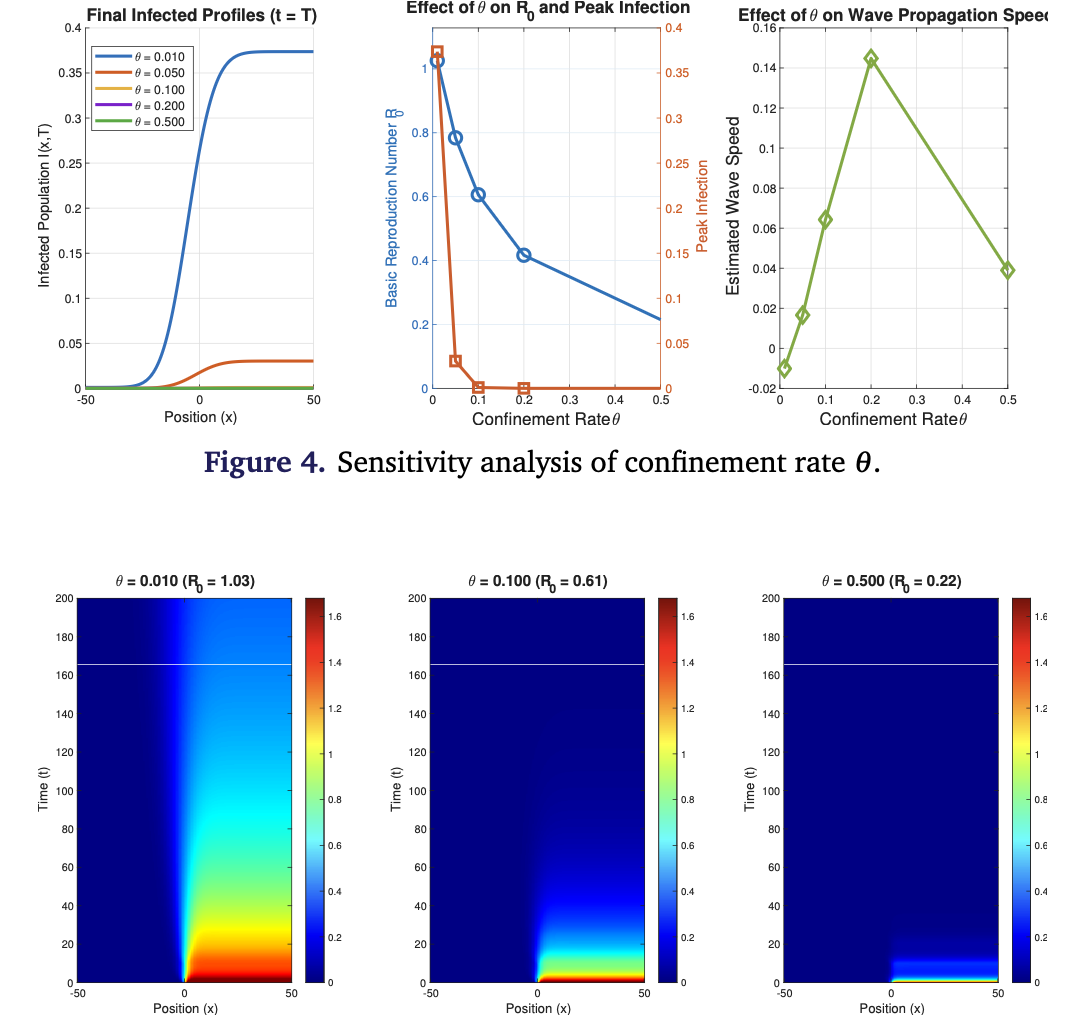
We study a delayed nonlocal epidemic model that includes the effects of confinement and a generalized incidence function. The model takes into account the spatial movements of the population through a nonlocal dispersal kernel and the behavioral control through a confinement parameter. First, we calculate the basic reproduction number $R_0$ and show its explicit dependence on the confinement rate. Second, we determine the minimal wave speed $\zeta^*$ of traveling wave solutions connecting the disease-free equilibrium to the endemic equilibrium. We show that $\zeta^*$ is given by the principal root of the corresponding characteristic equation and that (i) no traveling wave exists for $\zeta<\zeta^*$, and (ii) traveling waves exist for all $\zeta>\zeta^*$. Moreover, we show that the minimal wave speed is a monotone decreasing function of the confinement rate. Our results are obtained through a combination of spectral theory, upper-lower solution methods, and monotone iteration schemes that are modified to account for the joint effects of delay and nonlocal dispersal. Numerical simulations confirm the analytical prediction of the minimal wave speed and illustrate the quantitative slowing effect induced by confinement. These results provide a rigorous mathematical characterization of how mobility, delay, and confinement jointly determine epidemic invasion and spatial propagation.
Article Details

This work is licensed under a Creative Commons Attribution-NonCommercial 4.0 International License.
References
[1] Ruan S. Spatial-Temporal Dynamics in Nonlocal Epidemiological Models. In: Takeuchi Y, Sato K, Iwasa Y, editors. Mathematics for Life Science and Medicine. Berlin, Heidelberg: Springer; 2007. p. 97-122. doi:10.1007/978-3-540-34426-1_5.
[2] Wang W, Zhao XQ. Basic reproduction numbers for reaction-diffusion epidemic models. SIAM Journal on Applied Dynamical Systems. 2012;11(4):1652-73. doi:10.1137/120872942.
[3] Yaseen RM, Ali NF, Mohsen AA, Khan A, Abdeljawad T. The modeling and mathematical analysis of the fractional-order of Cholera disease: Dynamical and Simulation. Partial Differential Equations in Applied Mathematics. 2024;12. doi:10.1016/j.padiff.2024.100978.
[4] Li MY, Muldowney JS. Global stability for the SEIR model in epidemiology. Mathematical Biosciences. 1995;125(2):155-64. doi:10.1016/0025-5564(95)92756-5.
[5] Huang G, Takeuchi Y, Ma W, Wei D. Global Stability for Delay SIR and SEIR Epidemic Models with Nonlinear Incidence Rate. Bulletin of Mathematical Biology. 2010;72(5):1192-207. doi:10.1007/s11538-009-9487-6.
[6] Murray JD. Mathematical Biology: I. An Introduction. vol. 17 of Interdisciplinary Applied Mathematics. 3rd ed. New York: Springer; 2002. doi:10.1007/b98868.
[7] Shafeeq SK, Abdulkadhim MM, Mohsen AA, Al-Husseiny HF, Zeb A. Bifurcation Analysis of a Vaccination Mathe-matical Model With Application To Covid-19 Pandemic. Communications in Mathematical Biology and Neuroscience. 2022;2022:Article ID 86. doi:10.28919/cmbn/7633.
[8] Mimura M, Murray JD. On a diffusive prey-predator model which exhibits patchiness. Journal of Theoretical Biology. 1978;75(3):249-62. doi:10.1016/0022-5193(78)90332-6.
[9] Okubo A, Levin SA. Diffusion and Ecological Problems: Modern Perspectives. vol. 14 of Interdisciplinary Applied Mathematics. New York, NY: Springer New York; 2001. doi:10.1007/978-1-4757-4978-6.
[10] Feng S, Gao D. Existence of traveling wave solutions for a delayed nonlocal dispersal SIR epidemic model with the critical wave speed. Mathematical Biosciences and Engineering. 2021;18(6):9357-80. doi:10.3934/mbe.2021460.
[11] Guenad B, Darazirar R, Djilali S, Alraddadi I. Traveling waves in a delayed reaction–diffusion SIR epidemic model with a generalized incidence function. Nonlinear Dynamics. 2025;113(4):3673-93. doi:10.1007/s11071-024-10413-4.
[12] Darazirar R, Yaseen RM, Mohsen AA, Khan A, Abdeljawad T. Minimal wave speed and traveling wave in nonlocal dispersion SIS epidemic model with delay. Boundary Value Problems. 2025;2025(1). doi:10.1186/s13661-025-02055-1.
[13] Pei W, Yang Q, Xu Z. Traveling waves of a delayed epidemic model with spatial diffusion. Electronic Journal of Qualitative Theory of Differential Equations. 2017;2017(82):1-19. doi:10.14232/ejqtde.2017.1.82.
[14] Djilali S, Darazirar R, Alraddadi I. Traveling wave solution for a delayed reaction-diffusion two-group SIR epi- demic model with a generalized nonlinear incidence function. Journal of Applied Mathematics and Computing. 2025;71(Suppl 1):725-60. doi:10.1007/s12190-025-02474-4.
[15] Naim M, Helal MM, Yaseen RM, Mohsen AA. Dynamical, Stability, and Bifurcation of a Viral Model With General Cell- to-Cell Incidence Rate and Delayed Saturated CTL Immunity. International Journal of Mathematics and Mathematical Sciences. 2025;2025(1):4221570. doi:https://doi.org/10.1155/ijmm/4221570.
[16] Zhou J, Xu J, Wei J, Xu H. Existence and non-existence of traveling wave solutions for a nonlocal dispersal SIR epidemic model with nonlinear incidence rate. Nonlinear Analysis: Real World Applications. 2018;41:204-31. doi:10.1016/j.nonrwa.2017.10.016.
[17] Farman M, Alfiniyah C, Fatmawati F, Rois MA, Khadija J. Fractional-Order COVID-19 Model in Indonesia with Co- morbidity and Immunization : PID Control , Ulam-Hyers Stability , and Biosecurity Implications Fractional-Order COVID-19 Model in Indonesia with Comorbidity and Immunization : PID Control , Ulam-Hyers St. Jambura Journal of Biomathematics (JJBM). 2025;6(4):293-310. doi:10.37905/jjbm.v6i4.34027.
[18] Abdulkadhim MM, Mohsen AA, Al-husseiny HF. Stability analysis and Bifurcation for an Bacterial Meningi- tis Spreading with Stage Structure: Mathematical Modeling. Iraqi Journal of Science. 2024;65(5):2630-48. doi:10.24996/ijs.2024.65.5.23.
[19] Aprianti E, Sonia S. Stability and Sensitivity Analysis of Parameters in the SEIR-ASEI Model for the Transmission of Dengue Fever Stability and Sensitivity Analysis of Parameters in the SEIR-ASEI Model for the Transmission of Dengue Fever. Jambura Journal of Biomathematics (JJBM). 2025;6(4):340-9. doi:10.37905/jjbm.v6i4.32754.
[20] Yaseen RM, Mohsen AA, AL-Husseiny HF, Hattaf K, Zeb A. Improving the hepatitis viral transmission model’s dy- namics by vaccination and contrasting it with the fractional-order model. Partial Differential Equations in Applied Mathematics. 2024 jun;10:100705. doi:10.1016/j.padiff.2024.100705.
[21] Korobeinikov A, Maini PK. Non-linear incidence and stability of infectious disease models. Mathematical Medicine and Biology. 2005;22(2):113-28. doi:10.1093/imammb/dqi001.
[22] Smith HL, Zhao XQ. Global asymptotic stability of traveling waves in delayed reaction-diffusion equations. SIAM Journal on Mathematical Analysis. 2000;31(3):514-34. doi:10.1137/S0036141098346785.
[23] Liang X, Zhao XQ. Asymptotic speeds of spread and traveling waves for monotone semiflows with applications. Communications on Pure and Applied Mathematics. 2007;60(1):1-40. doi:10.1002/cpa.20154.
[24] Pazy A. Semigroups of Linear Operators and Applications to Partial Differential Equations. vol. 44 of Applied Mathe- matical Sciences. New York, NY: Springer New York; 1983. doi:10.1007/978-1-4612-5561-1.
[25] Wu J. Theory and Applications of Partial Functional Differential Equations. vol. 119 of Applied Mathematical Sciences. New York, NY: Springer New York; 1996. doi:10.1007/978-1-4612-4050-1.
[26] Smith H. Monotone Dynamical Systems: An Introduction to the Theory of Competitive and Cooperative Systems. vol. 41 of Mathematical Surveys and Monographs. Providence, Rhode Island: American Mathematical Society; 2008. doi:10.1090/surv/041.
[27] Zhao XQ. Dynamical Systems in Population Biology. New York, NY: Springer New York; 2003. doi:10.1007/978-0-387-21761-1.
[28] Shyamsunder, Purohit SD, Suthar DL. A novel investigation of the influence of vaccination on pneumonia disease. International Journal of Biomathematics. 2024 aug. doi:10.1142/S1793524524500803.
[29] Shyamsunder, Purohit SD. A novel study of the impact of vaccination on pneumonia via fractional approach. Partial Differential Equations in Applied Mathematics. 2024 jun;10:100698. doi:10.1016/j.padiff.2024.100698.